

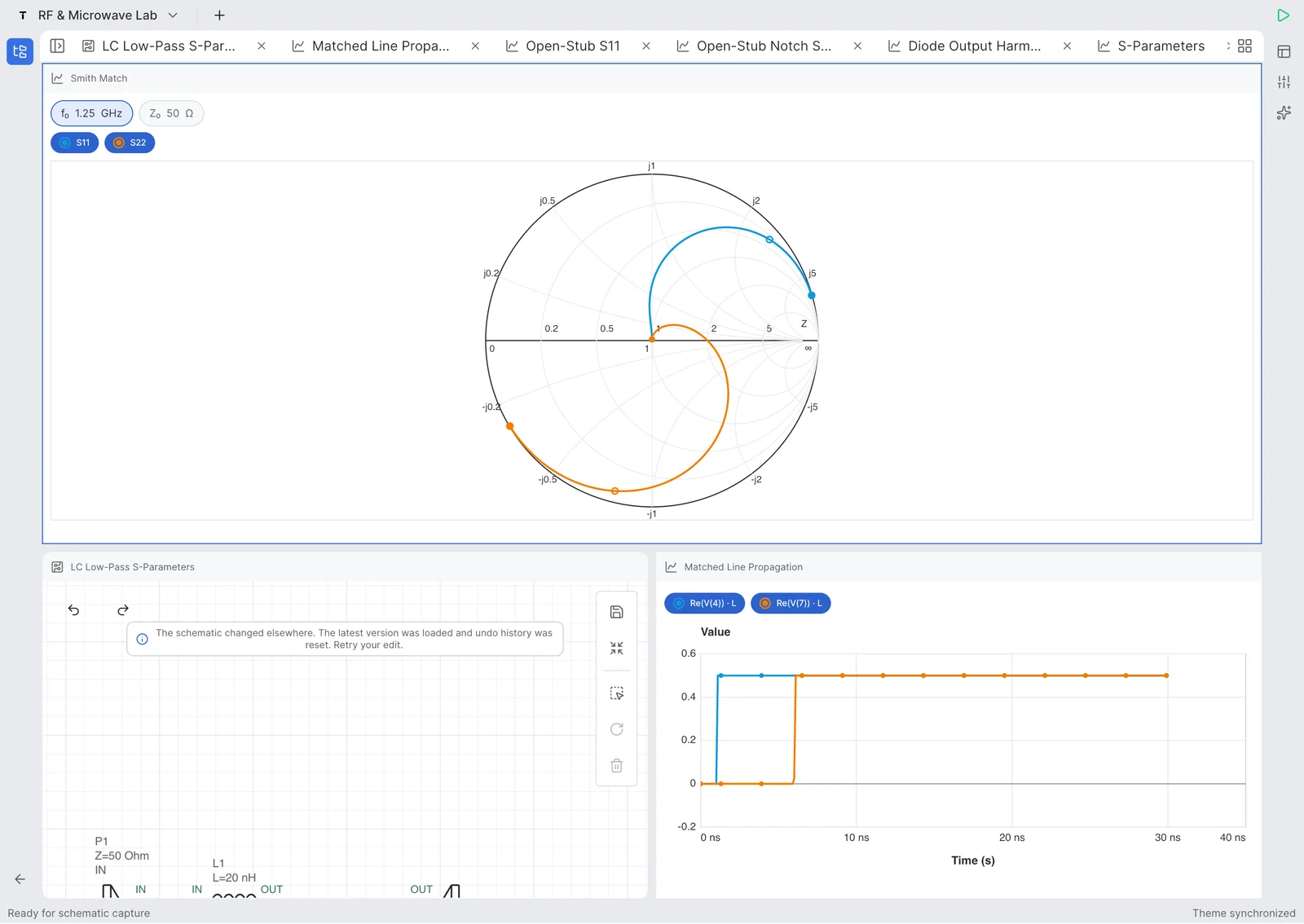
Editor esquemático
Desenhe circuitos analógicos e RF com portas, componentes, net labels e edição touch-friendly.
Tersa EDA é um app mobile e desktop para criar esquemáticos, rodar simulações, ajustar componentes e inspecionar medições RF.


Prova do produto
Monte um esquemático, escolha uma análise, adicione medições e ajuste valores sem sair do dispositivo.

Desenhe circuitos analógicos e RF com portas, componentes, net labels e edição touch-friendly.

Inspecione traces, marcadores, resposta em frequência e medições derivadas.

Analise parâmetros S, return loss, insertion loss, impedância e trajetórias na carta de Smith.
Updated July 27, 2026
Tersa EDA is an RF and analog circuit simulation workspace for engineers, students, and hardware teams who need a focused schematic-to-measurement flow. It combines schematic capture, SPICE-compatible analysis setup, plots, RF measurements, Smith chart inspection, and component tuning in one product surface. The goal is not to replace large desktop EDA suites. The product is designed for quick experiments, tablet review, mobile debugging, and focused circuit tuning when the important question is how the response changes after a component value, port, or measurement is adjusted.
Tersa EDA presents RF results around practical measurements: S11, S21, S12, S22, return loss, insertion loss, gain, stability-oriented traces, frequency markers, and Smith chart trajectories. The workflow starts from the schematic, adds ports and analysis settings, then keeps the plot and tuner connected to the circuit. This makes it useful for filters, matching networks, resonators, small-signal experiments, and quick RF review where the designer needs to compare traces instead of exporting data between separate tools.
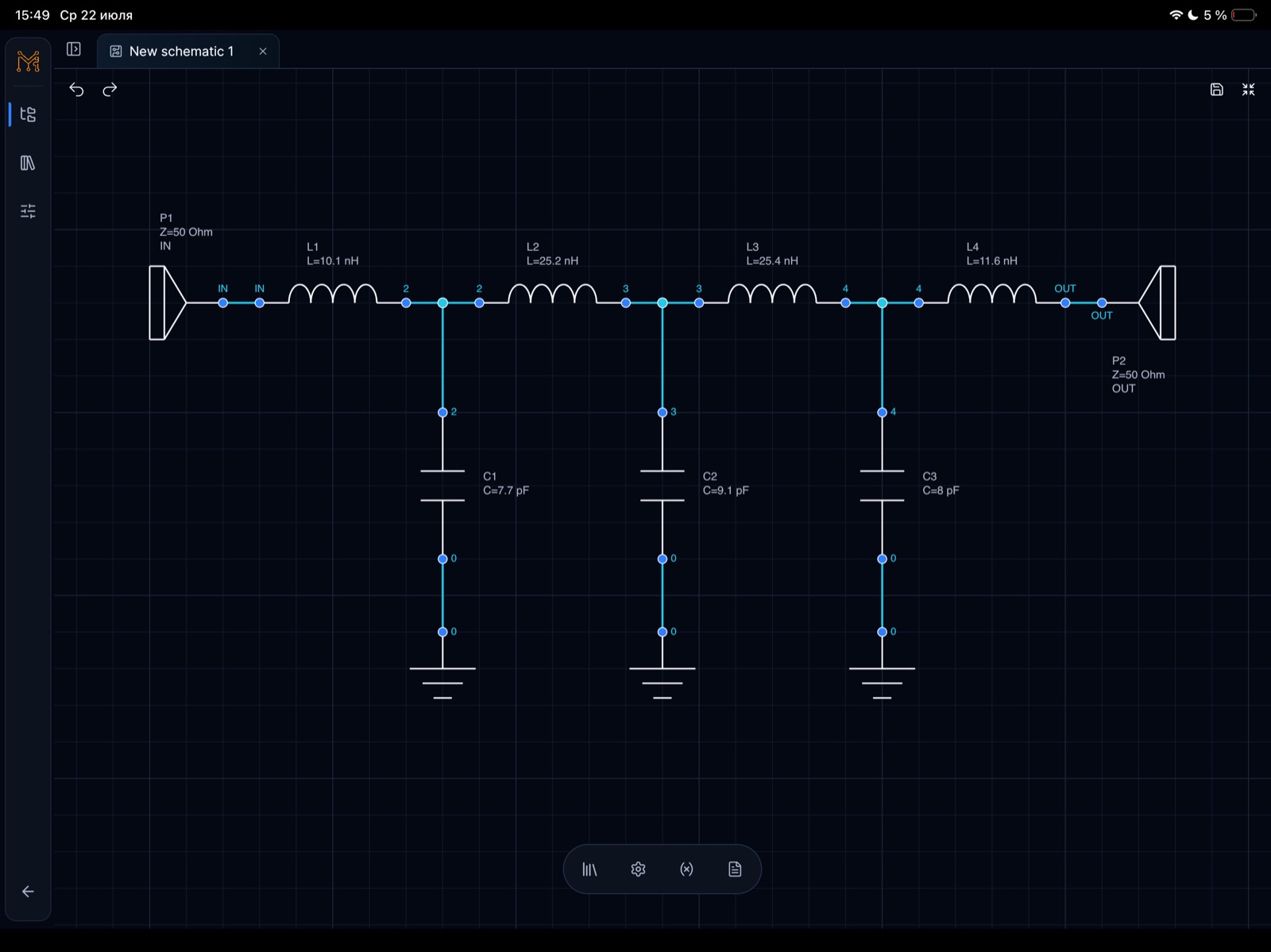
The 500 MHz low-pass filter example demonstrates a complete RF workflow on iPad. It shows a 50 ohm ladder filter with series inductors, shunt capacitors, input and output ports, S-parameter simulation to 1 GHz, insertion loss, return loss, and component tuning. The blue S21 trace shows passband behavior and roll-off, while the green S11 and S22 traces help inspect matching. The tuning sweep makes cutoff movement visible as capacitor and inductor values change around the target frequency.
Recursos
Crie circuitos com componentes, portas, labels e folhas reutilizáveis no celular, tablet ou desktop.
Rode análises AC, transientes e RF com gráficos limpos, marcadores e controles de traces.
Inspecione parâmetros S, return loss, insertion loss, cartas de Smith, ganho e métricas de estabilidade.
Ajuste valores de componentes e veja imediatamente como a resposta do circuito muda.
Fluxo de trabalho
Monte um esquemático, escolha uma análise, adicione medições e ajuste valores sem sair do dispositivo.
Posicione componentes, conecte nets e defina portas.
Rode simulações AC, transientes ou RF.
Plote tensões, parâmetros S, perdas e marcadores.
Altere componentes e compare a resposta.
Product demos
Vídeos curtos mostram criação de esquemas, simulação, medição e ajuste ao vivo de componentes no Tersa EDA.
Tune an RLC circuit directly on iPhone and watch the response update while component values change.
Abrir no YouTubeCreate an RLC schematic on iPhone, run simulation, and inspect the first measurement workflow.
Abrir no YouTubeUse the iPad workspace to tune resonance and compare circuit response changes on a larger engineering canvas.
Abrir no YouTubeBuild an RLC resonator from scratch on iPad and move from schematic capture into analysis setup.
Abrir no YouTubeRF example
A concrete LPF case study built in Tersa EDA: schematic capture, 50 ohm ports, S-parameter simulation, insertion loss, return loss, and component tuning around a 500 MHz target.
Target
500 MHz LPF
Ports
50 ohm IN / OUT
Analysis
S-parameters to 1 GHz
Workflow
Schematic, plot, tuner
This example shows a lumped 500 MHz low-pass filter workflow, not a generic screenshot gallery. The circuit uses a ladder topology with 50 ohm input and output ports, series inductors, shunt capacitors, and RF measurements plotted from DC to 1 GHz.
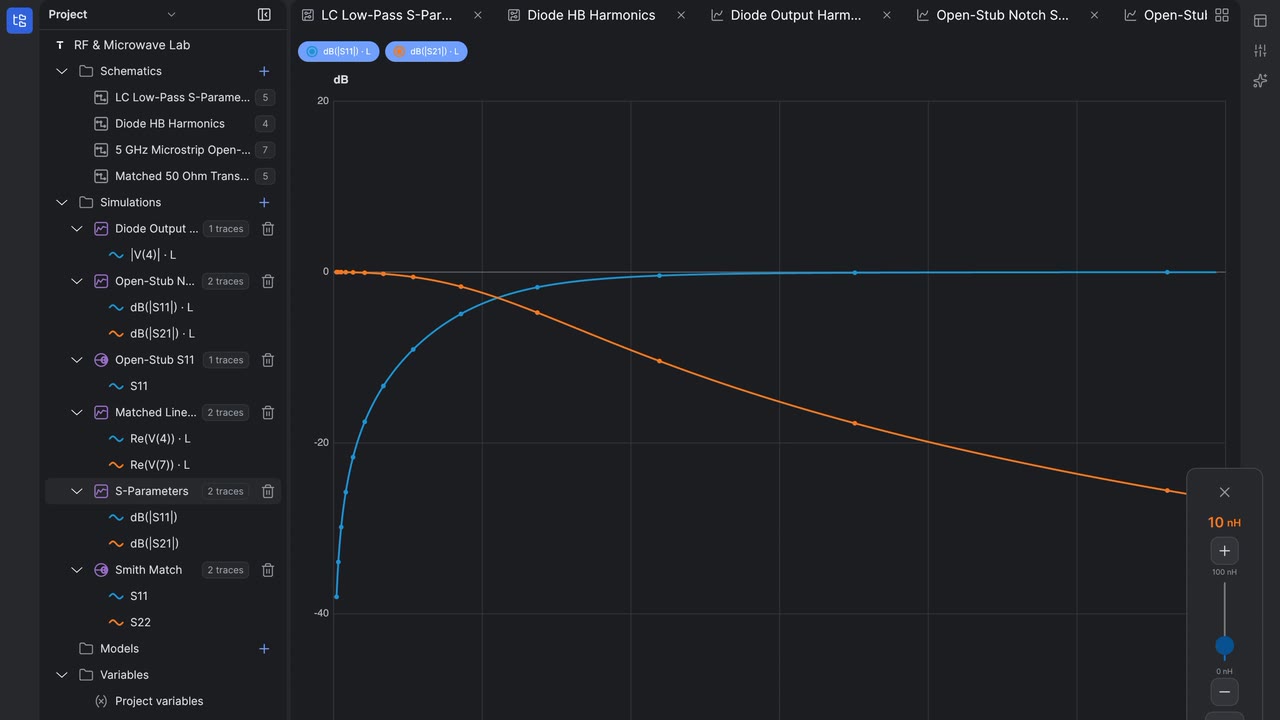
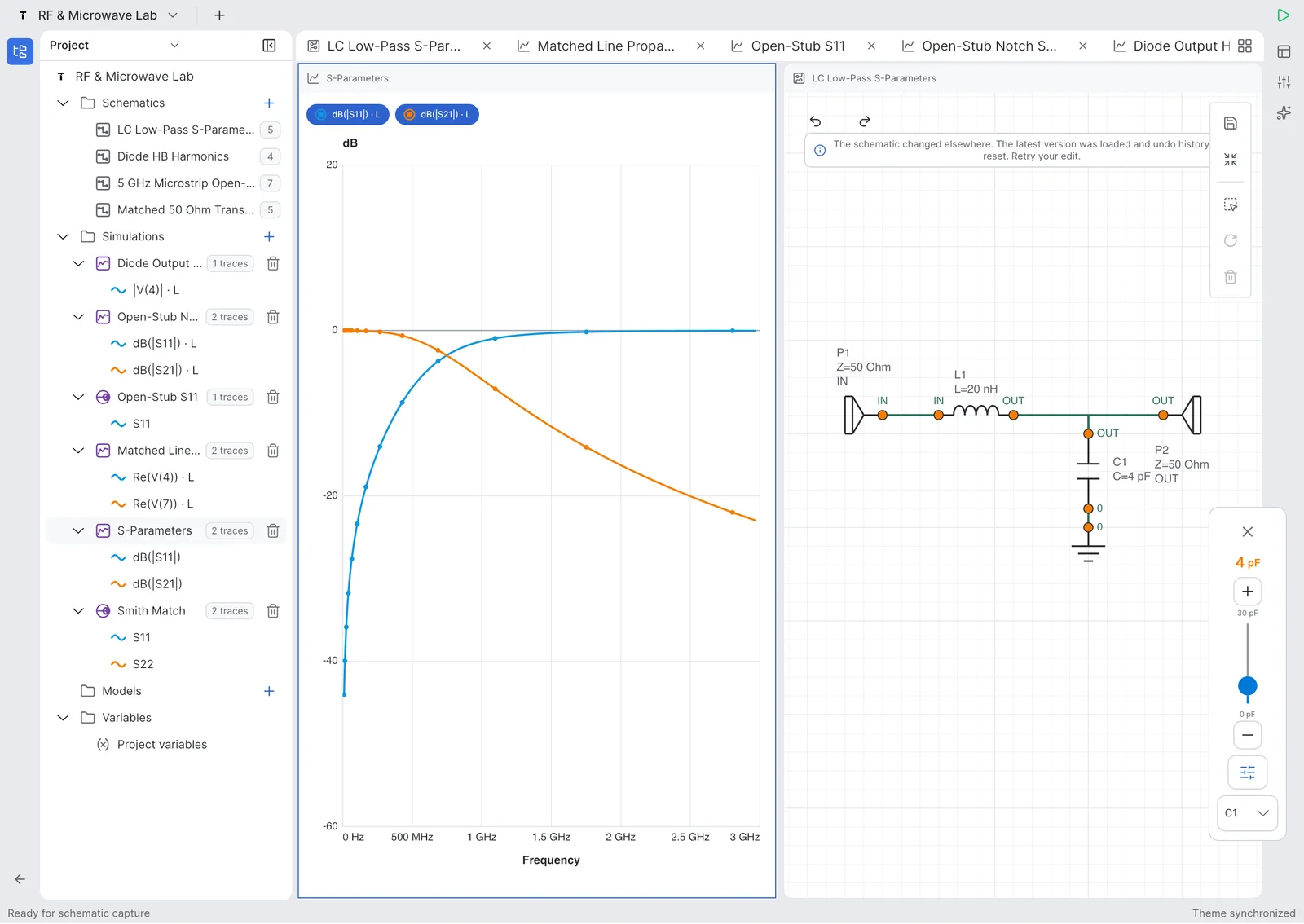
The blue S21 trace shows the passband and roll-off, while the green S11/S22 traces help inspect matching and return loss. Tuning sweeps make cutoff movement visible as component values change.


S-parameter response with S21 staying flat through the passband before the transition region toward 1 GHz.

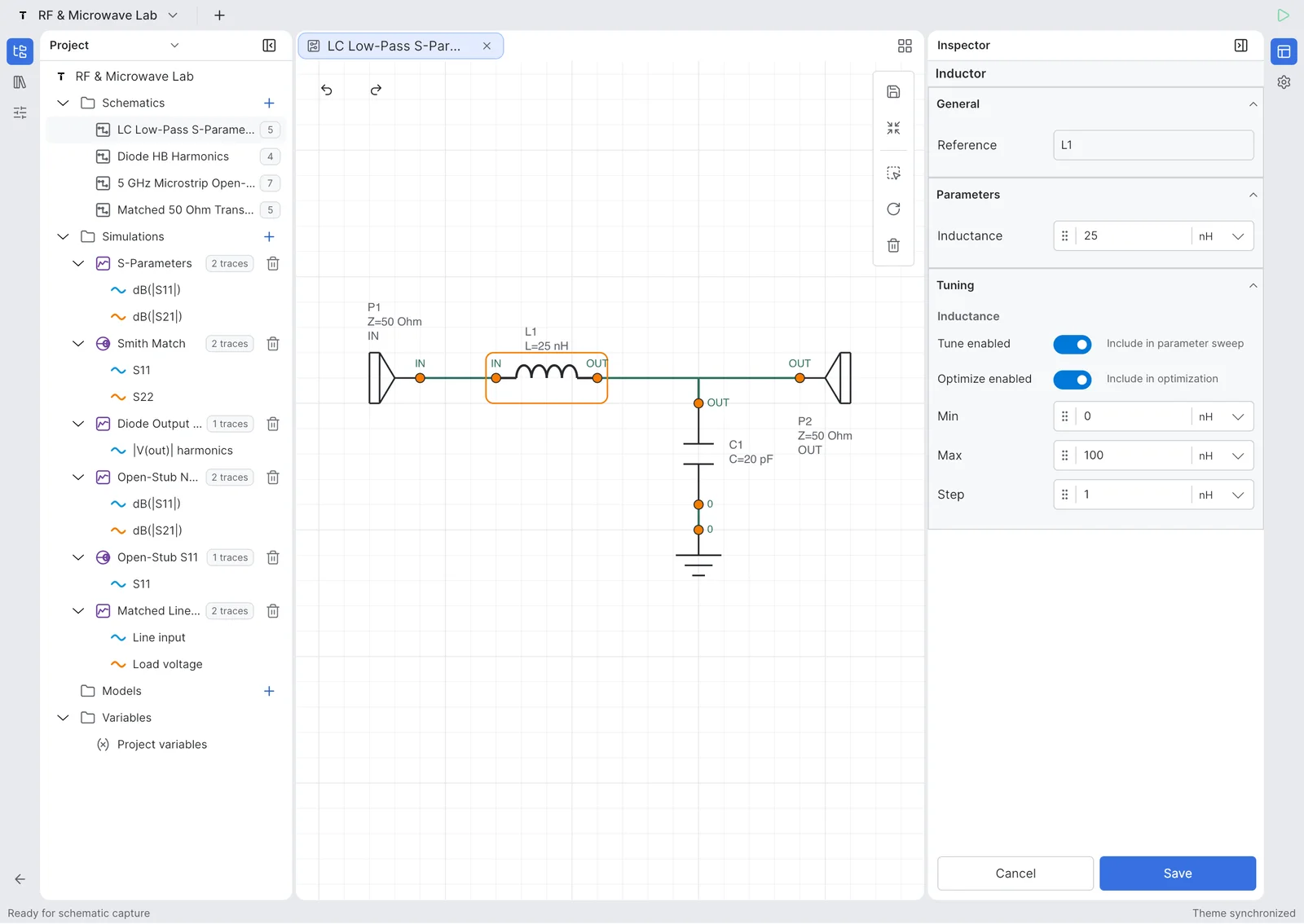
Tuning ranges expose capacitor and inductor values so the cutoff behavior can be optimized directly from the schematic.

A tuning sweep compares multiple S-parameter traces around the cutoff and stopband regions.

The project workspace keeps the LPF schematic, simulation plot, variables, and tunable parameters in one engineering flow.

Return loss and insertion loss traces make it possible to inspect passband fit and out-of-band rejection.
Ferramentas RF
Tersa EDA inclui medições RF junto da simulação analógica diária: parâmetros S, return loss, insertion loss, trajetórias em carta de Smith, ganho, estabilidade e marcadores de frequência alvo.


Analógico
Use Tersa EDA para filtros, divisores, amplificadores, circuitos com diodos, transientes RC, resposta em frequência e testes rápidos.
Capturas
Telas reais de projetos, edição esquemática, gráficos RF, carta de Smith e tuning.


Beta testing
Convidamos engenheiros, estudantes e equipes RF/analógicas para testar builds iniciais e dizer o que devemos refinar primeiro.
Ainda não. Tersa EDA foca em captura esquemática, simulação, medições, gráficos e tuning analógico/RF.
Não. É um workspace leve para experimentos rápidos, revisão mobile e tuning RF/analógico.
As primeiras versões focam circuitos analógicos, análises AC e transientes, parâmetros S, cartas de Smith e ajuste de componentes.
Não. A interface foi projetada para mobile, tablet e desktop.
Tersa EDA usa um workflow SPICE-compatible para análise de circuitos.